
Hepatitis C Disease Prediction Using Machine Learning Models With SMOTE-Based Data Balancing
DOI:
https://doi.org/10.51173/ijds.v3i2.82Keywords:
Hepatitis C, Machine Learning, Ensemble Learning, XGBoost, SMOTEAbstract
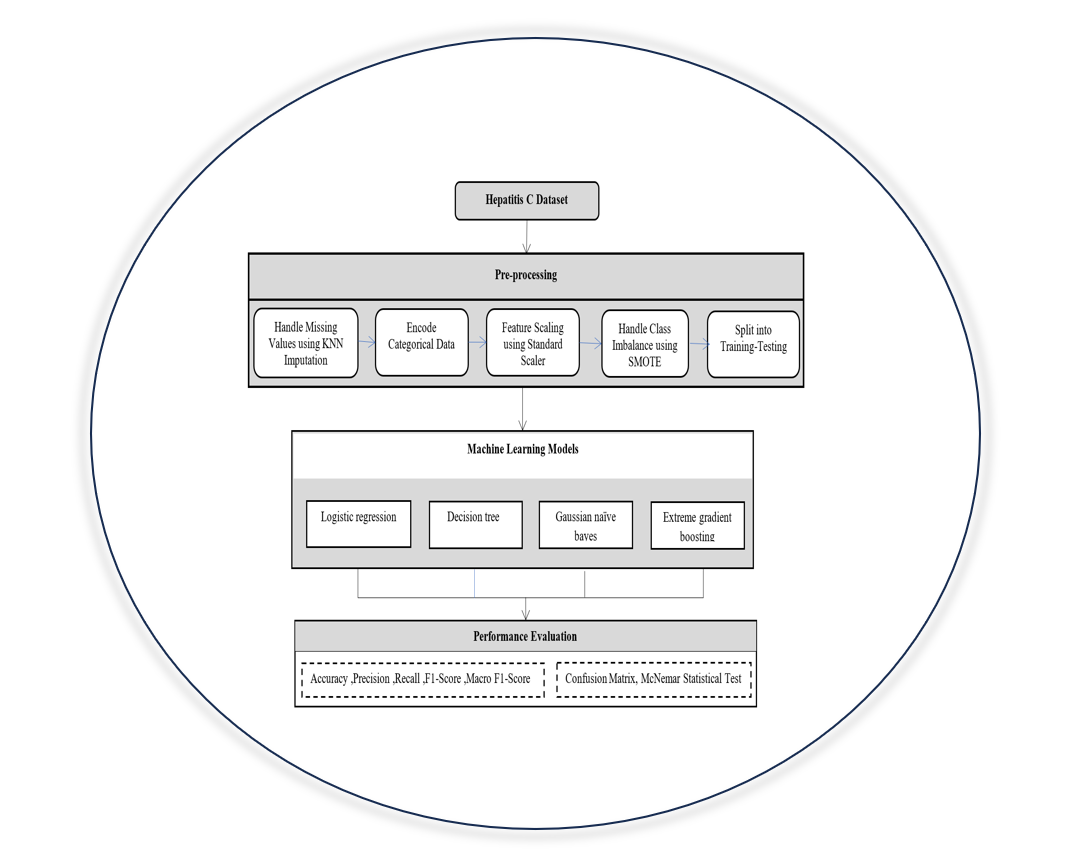
The problem of hepatitis C is worldwide, with many potential health issues associated with this serious disease (e.g., hepatitis C may lead to liver cirrhosis in some patients). Accurate and early diagnosis of Hepatitis C will improve patient care and possibly lower the death rate from this virus. This paper examined the use of machine learning models to classify patients' hepatitis C stage using laboratory-based clinical data from the hepatitis C dataset on Kaggle, with n=615 subjects. The data was split with 80% for training and 20% for testing. A preprocessing methodology was implemented on the dataset to obtain the best fit for multiple models. For example, missing data were imputed using KNN; categorical variables were encoded as numbers (label encoding); and each feature was scaled (standard scaler). To address class imbalance, we used the Synthetic Minority Over-sampling Technique (SMOTE). The models we implemented were: XGBoost, Random Forest, Decision Tree, Logistic Regression, and Gaussian Naïve Bayes. Our results show that the XGBoost/Synthetic Minority Over-sampling Technique performed best, achieving 95% classification accuracy and a macro F1 score of 0.95, compared to the other models we tested. The results provide additional evidence that combining SMOTE with ensemble learning offers a robust decision-support solution for classifying patients with Hepatitis C in a multiclass setting and an efficient means for early clinical diagnosis.
Downloads
References
J. Ferreira, J. Caldeira, M. Bicho, P. Faustino, and F. Serejo, "Hepatitis C Virus: An Overview of Its Chronic Impact on Liver Function, Metabolic Dysregulation, Inflammatory–Oxidative Pathogenesis and Epigenetic Memory," International Journal of Molecular Sciences, vol. 27, p. 3559, 2026, doi: 10.3390/ijms27083559.
E. Pose, S. Piano, M. Thiele, N. Fabrellas, E. Tsochatzis, and P. Ginès, "Moving diagnosis of liver fibrosis into the community," Journal of Hepatology, vol. 83, 2025, doi: 10.1016/j.jhep.2025.01.026.
H. Zilouchian, O. Faqah, M. Kabir, D. Gross, R. Pan, S. Shaifman, M. Younas, M. Haseeb, E. Thomas, and W. Asghar, "Current and Future Diagnostics for Hepatitis C Virus Infection," Chemosensors, vol. 13, p. 31, 2025, doi: 10.3390/chemosensors13020031.
Y. Zhu, "Predicting hepatitis C infection via machine learning," American Journal of Translational Research, vol. 17, pp. 5120–5128, 2025, doi: 10.62347/QXZB5406.
I. Shahid, A. Alzahrani, A. Al Ghamdi, I. Alanazi, S. Rehman, and S. Hassan, "Hepatitis C Diagnosis: Simplified Solutions, Predictive Barriers, and Future Promises," Diagnostics, vol. 11, p. 1253, 2021, doi: 10.3390/diagnostics11071253.
D. H. H. Le, S. Kanokudom, H. Nguyen, R. Yorsaeng, S. Honsawek, S. Vongpunsawad, and Y. Poovorawan, "Hepatitis C Virus—Core Antigen: Implications in Diagnostic, Treatment Monitoring and Clinical Outcomes," Viruses, vol. 16, p. 1863, 2024, doi: 10.3390/v16121863.
Y. Fahim, I. Hasani, S. Kabba, and W. Ragab, "Artificial intelligence in healthcare and medicine: clinical applications, therapeutic advances, and future perspectives," European Journal of Medical Research, vol. 30, 2025, doi: 10.1186/s40001-025-03196-w.
S. Auger and G. Scott, "Machine learning detects hidden treatment response patterns only in the presence of comprehensive clinical phenotyping," PLOS One, vol. 20, 2025, doi: 10.1371/journal.pone.0334858.
M. Salmi, D. Atif, D. Oliva, A. Abraham, and S. Ventura, "Handling imbalanced medical datasets: review of a decade of research," Artificial Intelligence Review, vol. 57, 2024, doi: 10.1007/s10462-024-10884-2.
A. Mohamed, M. Abdelrehim, and R. Al-Barazie, "Context matters in machine learning based disease prediction with insights from diverse clinical and symptom data," vol. 15, no. 1, p. 42669, 2025, doi: 10.1038/s41598-025-26855-8.
A. Ali, M. Hassan, F. Aburub, M. Alauthman, A. Aldweesh, A. Al-Qerem, I. Jebreen, and A. Nabot, "Explainable Machine Learning Approach for Hepatitis C Diagnosis Using SFS Feature Selection," Machines, vol. 11, p. 391, 2023, doi: 10.3390/machines11030391.
E. Onyema, S. Dalal, I. Ben Dhaou, C. C. Agubosim, C. Umoke, N. Richard-Nnabu, and N. Dahiya, "Artificial Intelligence-Based Ensemble Learning Model for Prediction of Hepatitis C Disease," Frontiers in Public Health, vol. 10, pp. 1–13, 2022, doi: 10.3389/fpubh.2022.892371.
P. Khatun, S. Umam, R. B. Razzak et al., "A study on the effectiveness of machine learning models for hepatitis prediction," Scientific Reports, vol. 15, p. 30659, 2025, doi: 10.1038/s41598-025-07104-4.
F. H. Yagin and A. Pinar, "Investigation of Hepatitis C diagnosis with machine learning and evaluation of clinical biomarkers with explainable artificial intelligence models," Medicine Science | International Medical Journal, vol. 14, p. 1309, 2025, doi: 10.5455/medscience.2025.04.092.
A. Ahad, B. Das, M. R. Khan, N. Saha, A. Zahid, and M. Ahmad, "Multiclass Liver Disease Prediction with Adaptive Data Preprocessing and Ensemble Modeling," Results in Engineering, vol. 22, p. 102059, 2024, doi: 10.1016/j.rineng.2024.102059.
T.-H. Li, H.-J. Chiu, and P.-H. Kuo, "Hepatitis C Virus Detection Model by Using Random Forest, Logistic-Regression and ABC Algorithm," IEEE Access, vol. 10, pp. 1–1, 2022, doi: 10.1109/ACCESS.2022.3202295.
D. E. Nishwa, Z. Abbas, and S. W. Lee, "Machine learning-based prediction of treatment response in comorbid hepatitis C patients receiving DAA therapy: A real-world study from Pakistan," Frontiers in Public Health, vol. 14, Art. no. 1783217, 2026, doi: 10.3389/fpubh.2026.1783217.
M. Hezari, M. Baes, A. Hezari, and M. Hassanbabaei, "Advanced Predictive Modeling for Hepatitis C Diagnosis Using Machine Learning," Clinical and Molecular Epidemiology, vol. 1, p. 12, 2024, doi: 10.53964/cme.2024012.
S. A. Farooq, "The Multiclass Detection of Five Stages of Hepatitis C Using the Machine Learning Based Random Forest Algorithm," pp. 1–6, 2023, doi: 10.1109/WCONF58270.2023.10235157.
A. Sharma, T. Khade, and S. M. Satapathy, "A cross dataset meta-model for hepatitis C detection using multi-dimensional pre-clustering," Scientific Reports, vol. 15, Art. no. 7278, 2025, doi: 10.1038/s41598-025-91298-0.
S. K. Sunori et al., "Predictive Modelling of Hepatitis C Virus Disease Progression Using PCA and Machine Learning," Biomedical & Pharmacology Journal, vol. 19, no. 2, 2026.
F. Soriano, "Hepatitis C Dataset," Kaggle, 2025. [Online]. Available: https://www.kaggle.com/datasets/fedesoriano/hepatitis-c-dataset
Lichtinghagen, F. Klawonn, and G. Hoffmann. "HCV data," UCI Machine Learning Repository, 2020. [Online]. Available: https://doi.org/10.24432/C5D612.
O. Rainio, J. Teuho, and R. Klén, "Evaluation metrics and statistical tests for machine learning," Scientific Reports, vol. 14, 2024, doi: 10.1038/s41598-024-56706-x.
C. Miller, T. Portlock, D. Nyaga, and J. O'Sullivan, "A review of model evaluation metrics for machine learning in genetics and genomics," Frontiers in Bioinformatics, vol. 4, 2024, doi: 10.3389/fbinf.2024.1457619.
Downloads
Published
How to Cite
Issue
Section